Rule of thirds
The rule of thirds divides an image into nine equal sections by imagining two horizontal and two vertical lines across the frame.
The key elements of your composition are ideally placed on one of the four intersection points.
These points naturally attract the viewer’s attention and create a more balanced and engaging composition.
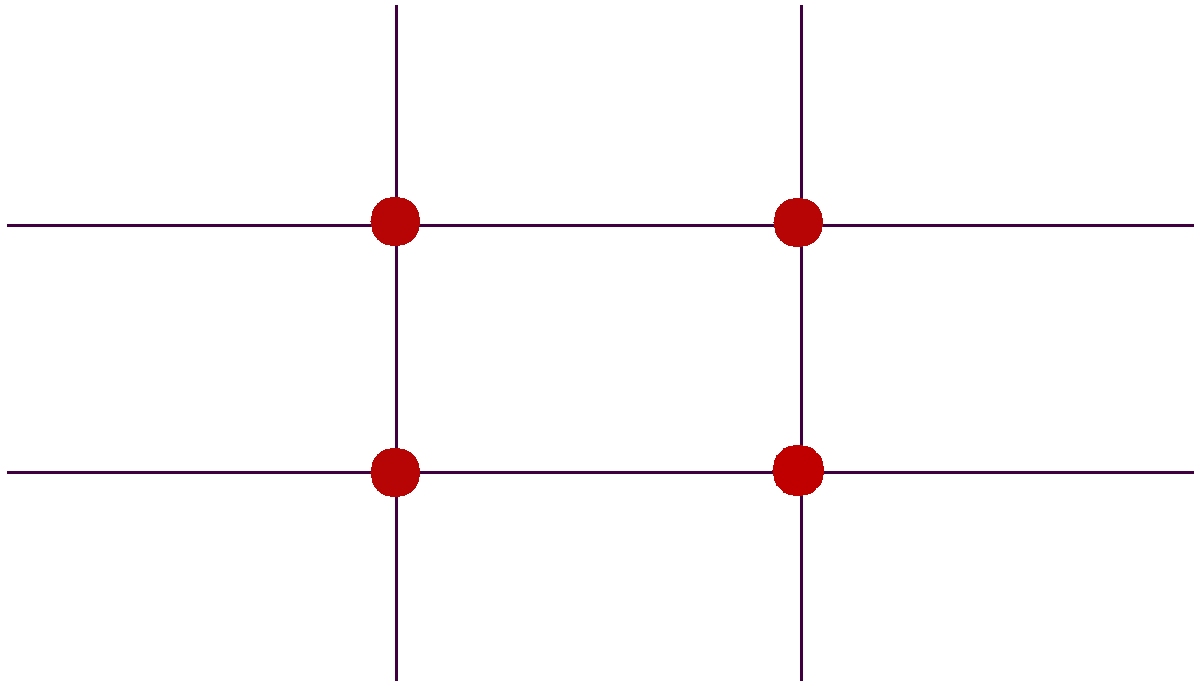
This principle works for almost any format—rectangular, square, or even circular— as long as the frame can be divided into nine equal parts.
How to use the rule of thirds
When composing a photograph, imagine two horizontal and two vertical lines dividing the frame into nine equal sections. Place important subjects near the four points where these lines intersect. This can help create a natural sense of balance and leave useful negative space around the subject.
Example
The following images demonstrate the impact of the rule of thirds.
In the first image, the main subject is not placed on a key intersection point, resulting in a busy and less focused composition.


The second image is a square crop of the first. Here, the main subject is positioned on a strong intersection point, creating a much more balanced composition.
Unnecessary distractions have been removed, and the direction of the fire (toward the upper right) has been carefully considered. The result is a far more dynamic and engaging image.
Viewfinder grid
Many cameras offer a grid overlay in the viewfinder, helping you compose your shots more effectively while shooting.
For example, Nikon provides this feature in the custom settings menu under display options. The grid divides the viewfinder into 16 sections and can help with composition, although it differs from the classic rule of thirds.
Other camera brands also offer similar grid systems, and some even display autofocus points arranged in a layout that loosely follows the rule of thirds.
While helpful, a grid is not essential. You can always refine composition later during post-processing—just like in the example images.
Related concept: Golden ratio
Alongside the rule of thirds, another widely used compositional guideline is the Golden Ratio. It follows a similar idea but with a slightly different, more mathematically refined structure.