What Is the Golden Ratio?
The Golden Ratio has its origins in ancient Greek mathematics and geometry. It describes a specific mathematical relationship between two parts of a whole.
The proportion is represented by the Greek letter Phi (Φ), with an approximate value of 1.6180339. Phi should not be confused with Pi (π), which is a different mathematical constant.
How Does the Golden Ratio Work?

A line AB is divided into two parts, AC and BC, so that the ratio of the entire line to the larger part is equal to the ratio of the larger part to the smaller part.
The Golden Ratio in Mathematics
This relationship can be expressed as: AB : AC = AC : BC. The resulting proportion is approximately 1.618.
In other words, the whole is approximately 1.618 times the larger part, while the larger part is approximately 1.618 times the smaller part.
The Golden Ratio in Art and Design
The Golden Ratio has been discussed and applied in art, architecture and design for centuries. Its historical use in specific works is sometimes debated, but the proportion has become a familiar concept in visual composition.
Golden Ratio vs. Rule of Thirds
The Golden Ratio and the Rule of Thirds are two different composition techniques. Both can help photographers position important elements within the frame, but they use different proportions.
The Rule of Thirds divides the frame into nine equal parts. The Golden Ratio uses unequal divisions based on the proportion 1.618.
The first image illustrates the Rule of Thirds; the second illustrates the Golden Ratio.
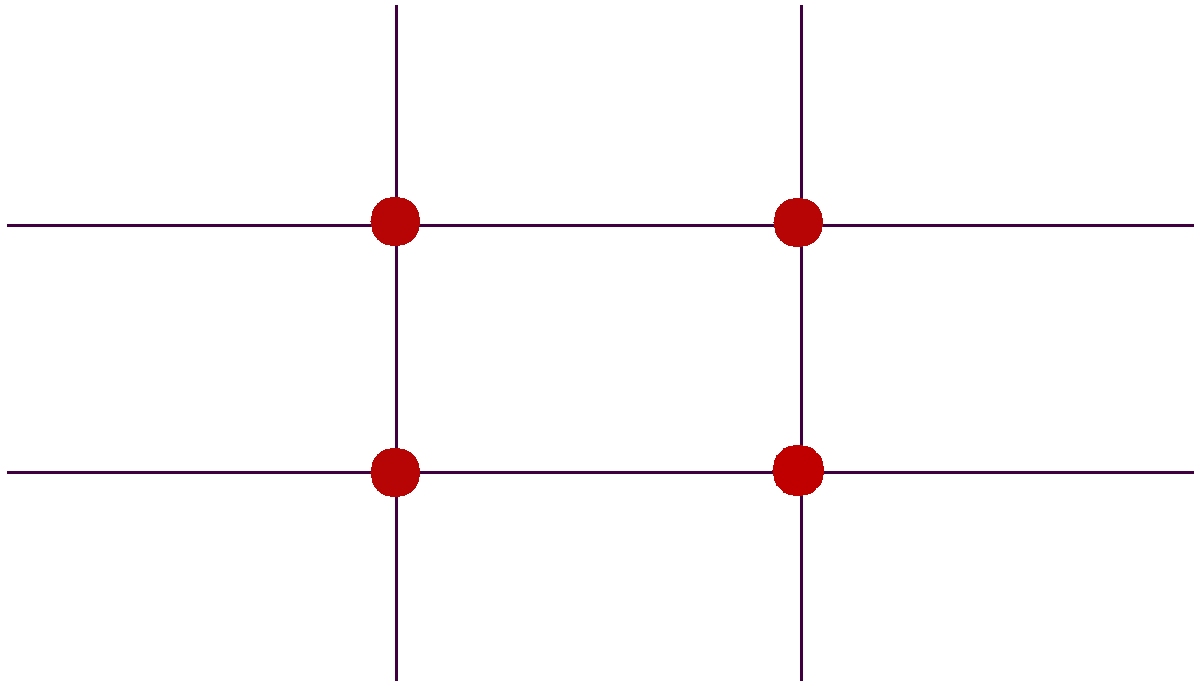
Golden Ratio Composition
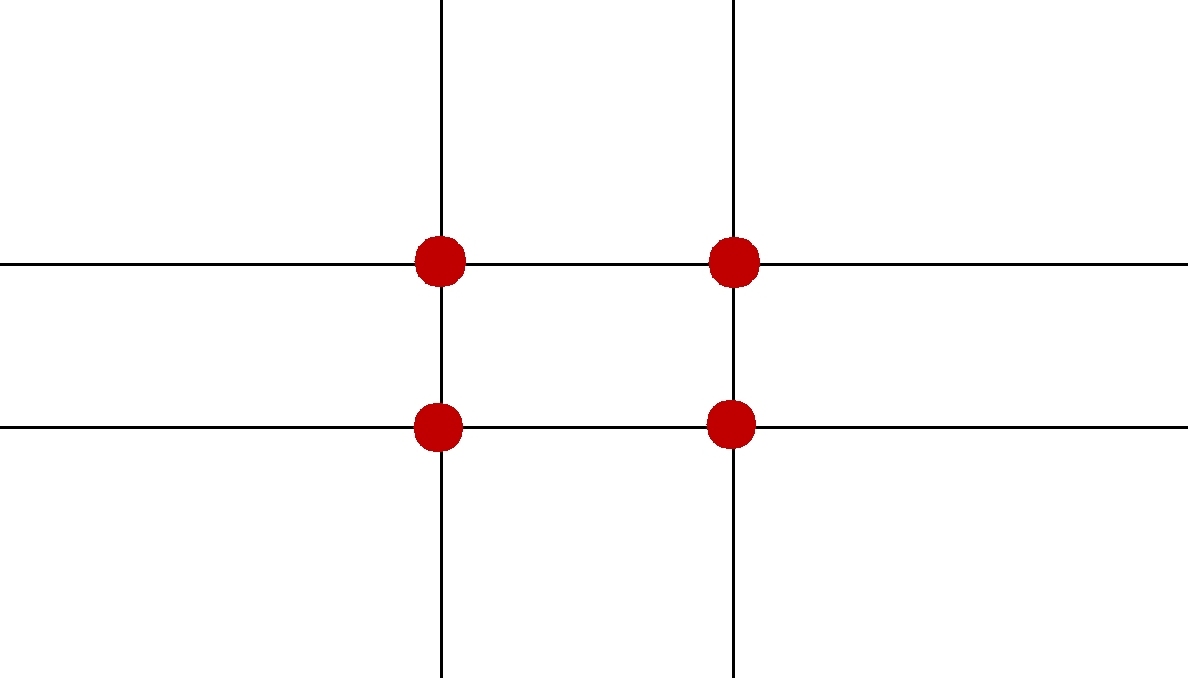
The Golden Ratio creates unequal divisions within the frame. Its proportions can be used to position subjects, lines and other important elements in a composition.
Key Idea
Important elements can be positioned near points or lines derived from the Golden Ratio. This can help create a sense of balance and visual harmony, although effective composition does not depend on a single mathematical rule.
Where Does the Golden Ratio Come From?
The Golden Ratio has been known in mathematics for a very long time and is also known as the golden proportion. The Latin expression divina proportia became associated with the proportion through the work of Luca Pacioli in the Renaissance.
Similar proportions can also be observed in some natural patterns. However, claims that the Golden Ratio is present throughout nature should be treated with care, as many such examples depend on how patterns are measured or interpreted.
Fibonacci
Another important name associated with the Golden Ratio is Fibonacci, the Italian mathematician Leonardo of Pisa (c. 1170–c. 1240).
The Fibonacci Sequence
In the Fibonacci sequence, each number is the sum of the two preceding numbers. The sequence begins:
0, 1, 1, 2, 3, 5, 8, 13, 21, 34, 55, 89, 144, 233…
Each new number is produced by adding the previous two numbers together.
Patterns in the Fibonacci Sequence
The Fibonacci sequence contains many interesting mathematical properties. For example, the sum of any ten consecutive Fibonacci numbers is divisible by 11.
The sequence also contains recurring numerical patterns and relationships that make it an important subject in mathematics.
Fibonacci and the Golden Ratio
The connection between the Fibonacci sequence and the Golden Ratio becomes apparent when consecutive Fibonacci numbers are divided. As the numbers become larger, the resulting ratios approach 1.618, the value of Phi.
Examples
89 ÷ 55 ≈ 1.618
21 ÷ 13 ≈ 1.615
233 ÷ 144 ≈ 1.618
The small differences gradually become smaller as the Fibonacci numbers increase, and the ratio converges toward the Golden Ratio.
The Golden Ratio Spiral
The Golden Ratio can also be represented visually by a logarithmic spiral. The diagram below illustrates a spiral constructed using proportions related to the Golden Ratio.

Spiral patterns can be found in a variety of natural forms, although not every spiral in nature follows the Golden Ratio exactly.
Conclusion
The Golden Ratio is a mathematical proportion that can be used as a guide for photographic composition. It provides one possible way to organise visual elements and create a sense of balance and harmony.
The Rule of Thirds is a separate composition technique. It is simpler to apply because it divides the frame into nine equal parts, while the Golden Ratio uses unequal proportions based on 1.618.
Summary
The Golden Ratio combines mathematics and visual composition. Photographers can use its proportions as a creative guide, but strong compositions can also be created without following a mathematical rule.